Building a workflow with AI now takes 40 seconds. Checking it takes 40 minutes. That is the line I keep from the opening keynote of In the Loop, the first n8n conference, on 14 October 2026 in Berlin.
A week ago, I wrote on LinkedIn what I was watching for: MCP, more autonomous yet controllable agents, human-in-the-loop. I shared my first impressions on the day. Here is the long version: the figures, Jan Oberhauser’s vision, David Roberts’s product announcements, and what it all means for people who build with n8n.
In the Loop: n8n comes home
In the Loop 2026 is the first major n8n conference. It took place on 13 and 14 October 2026 at Wilhelm Studios in Berlin, the city where n8n started in 2019. The event website sums it up in one line: “We’re coming home”.
- 13 October, Partner Day: invite-only day for partners and ambassadors.
- 14 October, Ecosystem Day: open to everyone, with keynotes, talks, workshops, an expo and an open mic.
- Capacity: 1,200 attendees at most, plus the live stream.
- Sponsors: SAP, Accenture, Capgemini, Avanai, Exxeta and SVA.
The opening keynote on 14 October had two parts. Jan Oberhauser, founder and CEO, covered the vision and the “why”. David Roberts, VP Product & Design, then walked through the product: what has shipped, what is coming and what is still being explored.
The key announcements
n8n in numbers
Jan Oberhauser opened with the scale reached since the first line of code, written in Berlin in 2019.
| Metric | Announced value |
|---|---|
| Active workflows per month | 6.7 million |
| Fortune 500 companies using n8n | 60% |
| Valuation after the SAP investment | €5.2 billion |
| Community members | 519,000 |
| Published templates | 13,000 |
| Integrations | 2,300 |
| Ambassadors | 340 |
| GitHub stars | 207,000 (top 30 of all time) |
| Active partners | 400 |
The vision: “More capable AI should create more capable people”
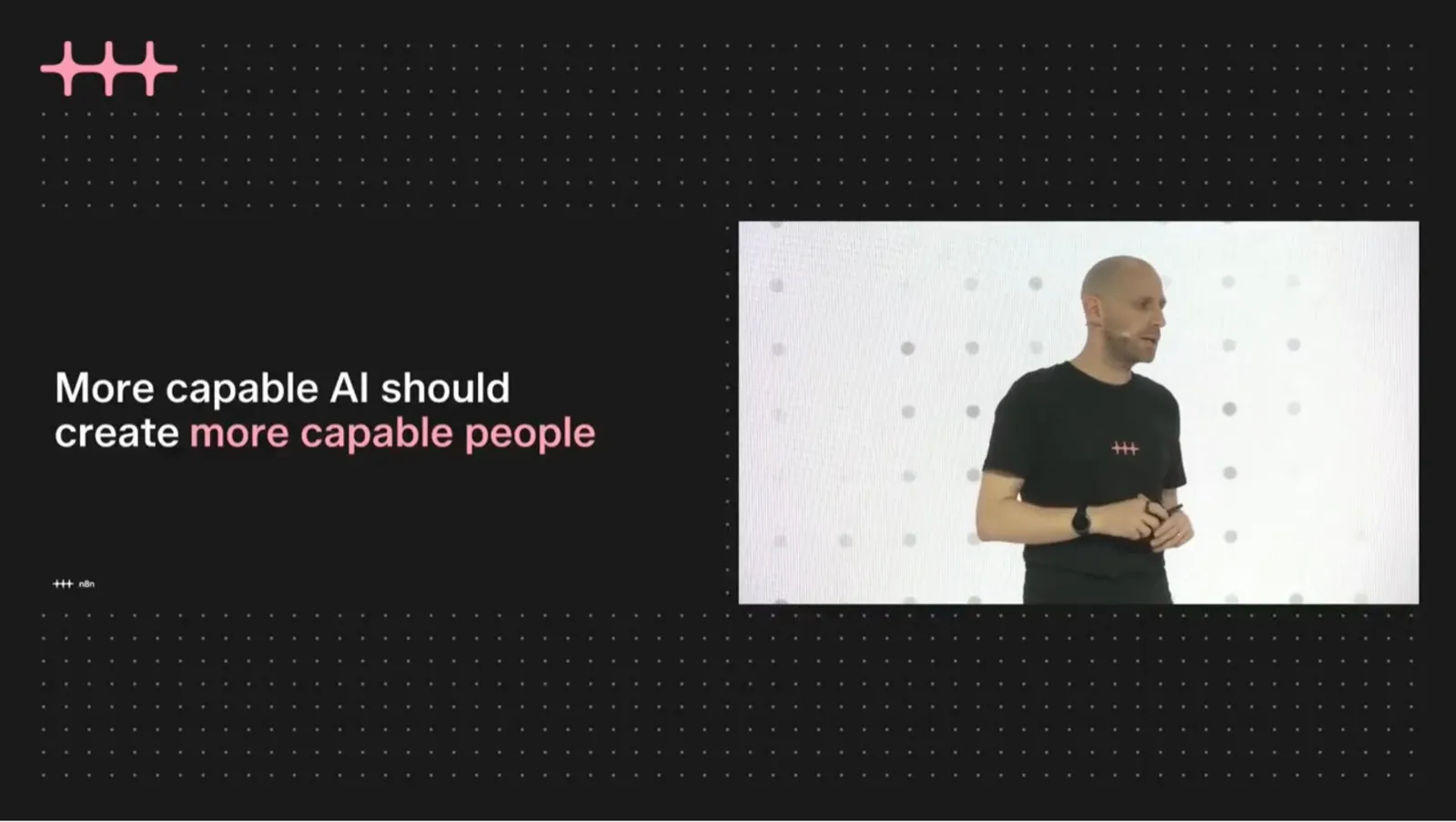
Jan asks a single question: as AI gets smarter every month, what happens to people? n8n bets on the path where humans understand more and stay in control.
His argument is a chain: visibility → understanding → control → agency. Remove the first link and everything falls. Hence four questions before trusting an automation: what goes in, what happens, what comes out, and who is accountable?
Two ideas follow:
- The UI is the trust layer. It does not fade away with AI; it makes actions, boundaries and responsibility readable.
- The more critical the process, the more you need to see it. A personal task: the result is enough. A shared team process: the key steps. A business-critical operation (payroll, customer onboarding, anything regulated): every step.
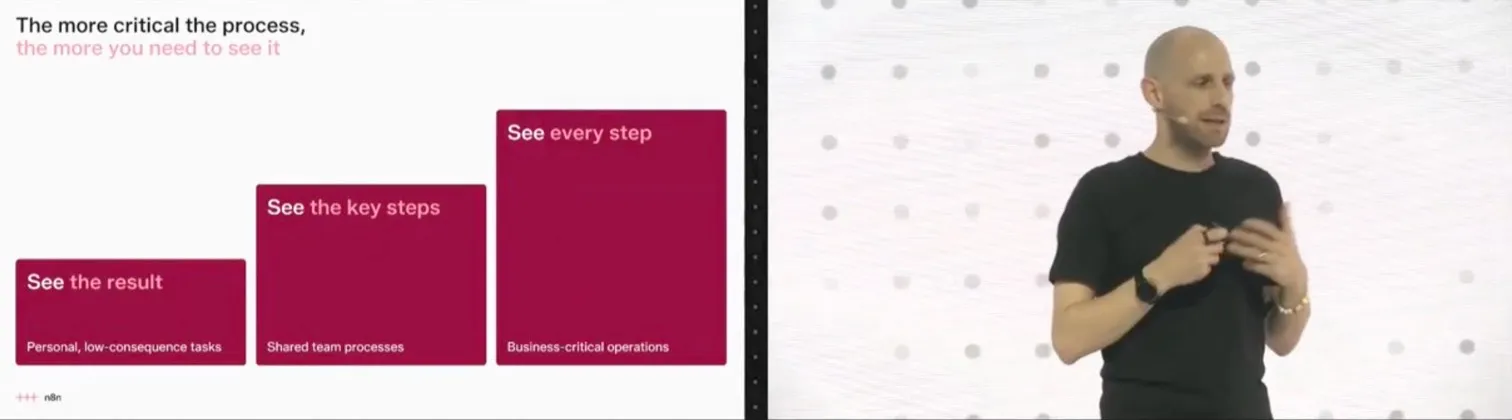
Visibility follows criticality: the result, the key steps, or every step.
The new positioning: “AI makes intelligence possible. n8n makes intelligence operational.” n8n wants to grow from a product into an operating system for AI-powered work. Critical work needs four building blocks: agents (judgment and language), deterministic software (one right answer), automation (repeatable steps at any volume) and people and teams (ownership and the final call).
A rebrand and n8n Labs
Max, “the original Flowgrammer”, unveiled the new identity. The old logo celebrated the nodes; the new one celebrates the space between them, where the connection happens. The colour stays.
Jan also introduced n8n Labs, a small team exploring new products under three rules: speed and signal over polish, build for the capability curve rather than the current model, and default to shutting things down. A first Labs product was teased at the end of the keynote, with a waiting list.
What will never change
- Community Edition: free, self-hosted, with the source open to read.
- Model choice: your models, your providers.
- Equal treatment of free and paying users.
- 50% of engineers stay focused on the n8n core.
The product, by David Roberts
David Roberts structured his part around the lifecycle of an automation: build, audit, deploy, monitor, govern.
Already shipped:
| Feature | What it does | Announced result |
|---|---|---|
| Agents (October) | Agents taken out of workflows and put on the same level, better MCP and Slack support | 20% more likely to reach production |
| AI Assistant | Builds workflows from natural language, on Cloud and self-hosted | 1.6M conversations, 800,000 workflows, 8 in 10 users satisfied |
| MCP for building | Connect Claude, Codex or another coding agent to n8n | 3x more workflows, 3.4x more likely to succeed |
| n8n Connect | Sets up selected credentials automatically | Used by 25% of users, 25% higher success rate |
Coming next:
- Simpler evaluations. Only 15% of teams run evals, yet teams with rigorous evals have a 70% chance of excellent reliability (32% without). n8n wants to surface only the business decisions and handle the rest with AI.
- A new execution engine, rewritten from the ground up: progress saved after every step, a reconciliation suite for stuck jobs, automatic retries only on steps marked safe, sandboxed code, worker pools, resource isolation.
- Manifest, a separate observability tool for multi-instance setups: what exists, what runs, who owns it, which systems are touched. In testing, open to multi-instance users.
- Governance along four axes: access, guardrails, ownership and quality, security. Eventually with agent identities of their own, narrow, attributable and revocable, instead of borrowing a person’s login.
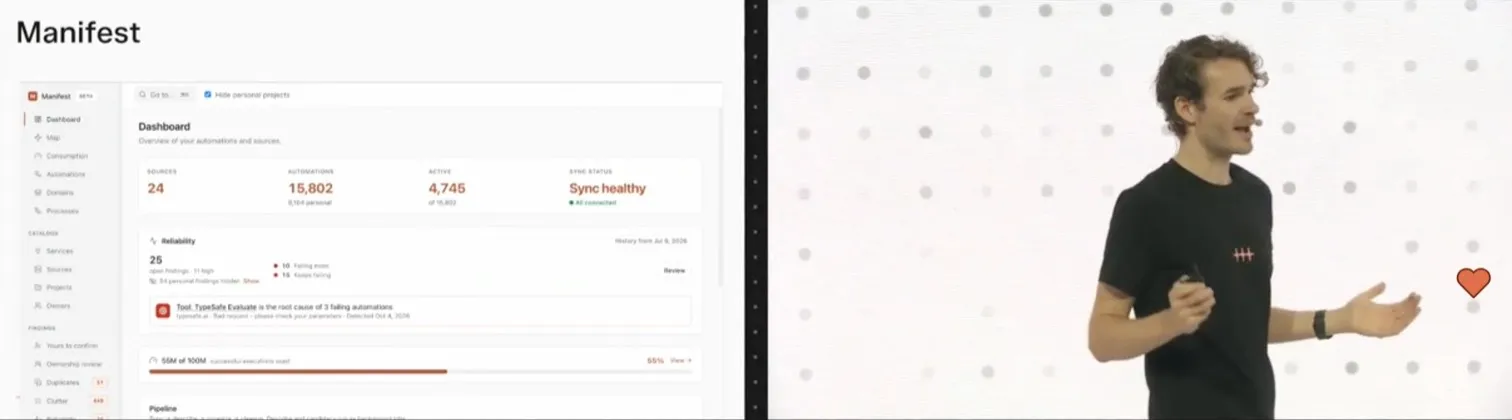
First look at Manifest, n8n’s multi-instance observability.
What it means for n8n builders
1. Agent first, workflow second. The agent becomes the entry point: you describe an outcome, it finds the path. But David Roberts is clear: an agent doing the same thing 10,000 times a day is just a very expensive workflow. The rule of thumb: if the thinking happens once, at design time, it is a workflow; if it happens on every run, it is an agent.
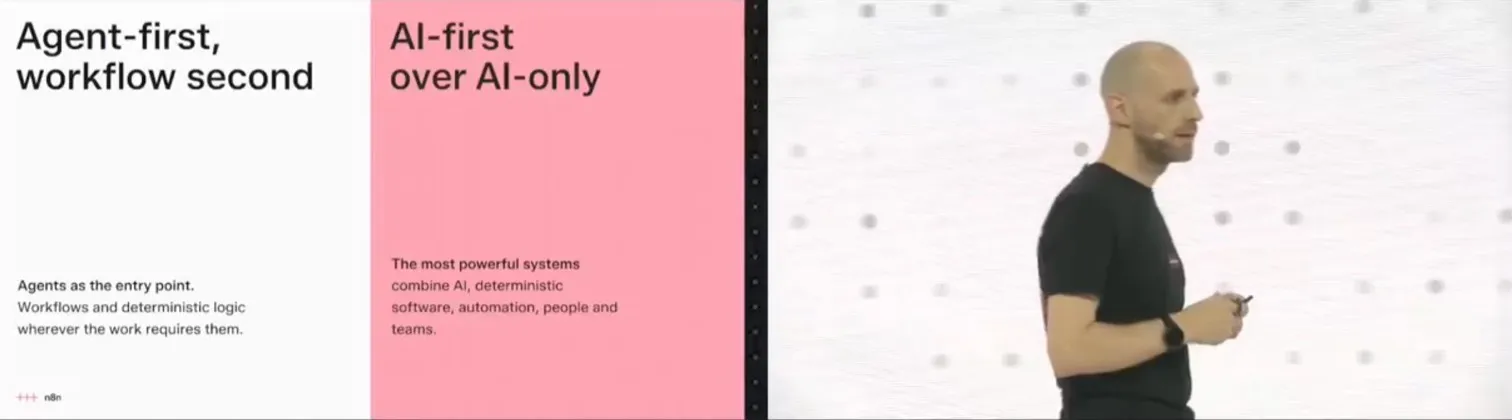
Agent-first, workflow second: agents as the entry point, deterministic logic wherever the work requires it.
2. Make deterministic whatever can be. Reliability multiplies along a chain: 10 steps at 95% each give a system that is 60% reliable (0.95 to the power of 10). The advice: take business logic out of the agent and wrap it in deterministic tools. The example given: a single “onboard a user” tool rather than three Slack, Google Workspace and Salesforce tools left to the agent’s choice.
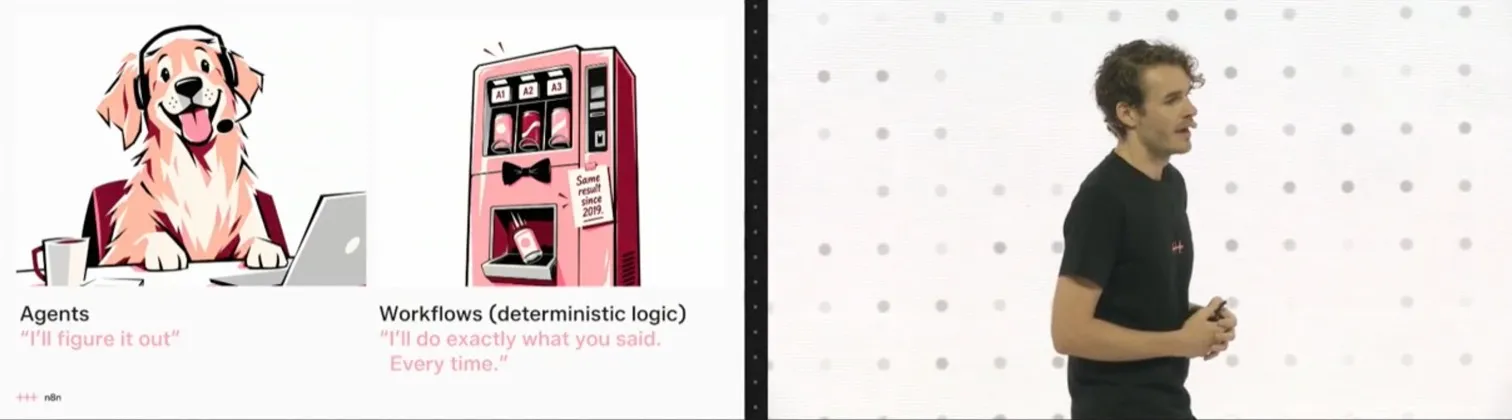
The agent “figures it out”; the workflow “does exactly what you said, every time”.
3. The bottleneck has moved from building to auditing. You build in 40 seconds and check for 40 minutes. There are two ways to audit: inspection (reading the logic, the job of the canvas) and testing (running it and checking the results, the job of evals). Of 1,127 users surveyed, 55% said n8n would lose much of its meaning without the canvas. The canvas stays.
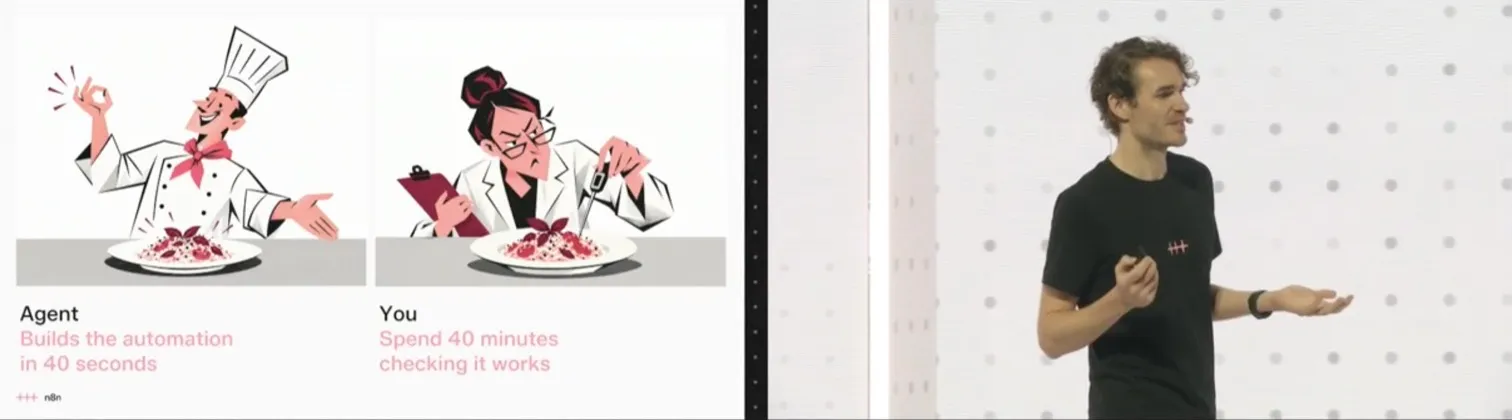
The new bottleneck: the agent builds in 40 seconds, you check for 40 minutes.
4. Trust is earned in stages. First the agent suggests and the human acts. Then the agent acts and the human approves spending. Finally the human sets a budget and walks away. Budgets are a partial answer to “approval fatigue”: clicking “OK” a hundred times without reading.
5. Governance is no longer for large companies only. Soon there will be more agents than employees, even in small businesses. Shadow IT is no longer a spreadsheet macro; it is a cluster of agents with access to sensitive systems.
Two customer stories show the range. Mercedes-Benz chose n8n as its global automation platform, layered and cloud agnostic. At the other end, a small US agency turns WhatsApp voice notes into CRM updates: from 4-5 minutes down to 10-20 seconds per note, and a sales cycle cut from 62 to 44 days.
My take: the real battle is visibility in production
What stands out to me is that n8n did not give a “magic AI” keynote. The common thread, from Jan’s talk to David’s roadmap, is trust: seeing every step, auditing, monitoring, governing. Building with AI has become easy; knowing what runs on a Sunday night, when nobody is watching, has not.
That is exactly the problem I work on with N8Ninja, my app to manage and monitor n8n automations from Apple devices. I released version 1.2.1 for the occasion. It answers several of the questions raised on stage:
| What the keynote said | What N8Ninja 1.2.1 does |
|---|---|
| “The more critical, the more you need to see each step” | Debug logs with the JSON input and output of every node |
| Monitoring: keeping an eye on what runs | Status, duration and errors of each execution; workflow health over 48 h and 7 days |
| Trusting it runs when nobody is watching | Failure alerts, with background notifications on Mac |
| Security, the fourth pillar of governance | Security audit with a risk estimate |
N8Ninja runs on iPhone, iPad, Mac, Apple Watch and Apple TV, with n8n Cloud as well as self-hosted instances. Manifest targets observability for large multi-instance organisations; N8Ninja targets the builder who wants the state of their workflows in their pocket.
In short
n8n set a clear course in Berlin: AI builds, people understand and decide. Agents as the entry point, workflows for reliability, and a big push on auditing, the execution engine, observability and governance. The Community Edition and model choice remain guaranteed.
To go further:
- Watch the full keynote on YouTube.
- Try the AI Assistant or connect your coding agent through MCP, if you have not yet.
- Get in touch with n8n to test Manifest if you run several instances.
- Monitor your workflows from your iPhone, Mac or Apple Watch with N8Ninja.
Which announcement matters most to you? Tell me in the comments of my LinkedIn post.
Sources
- In the Loop 2026, official website
- Livestream: Opening keynote and Product direction (YouTube)
- n8n on LinkedIn: the day in pictures
- n8n on LinkedIn: community moments
- My notes, the keynote transcript and my captures of the live stream